
Start a Warren County Property Search
The county property search takes several starting points. A town, parcel ID, prior ID, property location, or owner name all work. It is the practical first stop when an address is known. The master record connects that address to the tax map identity, assessment data, owner display, and sales view. The county's current Vinyl real-property application offers another route. It relies on JavaScript and a live session. When one interface fails, simplify the town and address wording. Then try the other official path.
Treat a parcel result as a lead, not a title conclusion. The assessment roll exists for tax administration. GIS lines are reference geometry. An owner field may refresh only after a deed is recorded, so timing matters too. For a purchase, estate, easement, or disputed boundary, compare the parcel card with the newest County Clerk instrument. Check any filed survey as well. Certified records or a title professional may still be needed.
- Search the county property portal by address and note the municipality, print key, SBL, and displayed owner.
- Use the owner name in SearchIQS and read the newest deed, including its recording date, book, page, and legal description.
- Check the correct final assessment roll and the tax system, separating assessment data from bill and payment status.
- Open the parcel in GIS and compare geometry, zoning, imagery, and the parcels around it.
- Ask the record room, local assessor, treasurer, or archives for material that is not exposed online.
Warren County Records Custodians
No single Warren County office holds the whole property trail. Deeds, mortgages, liens, judgments, lis pendens, and filed maps all belong to the County Clerk. Real Property Tax Services supports municipal assessment rolls, tax maps, transfer reporting, and parcel data. Each local assessor handles parcel-specific questions. Current tax bills begin with the local collector. County delinquency and foreclosure matters move to the Treasurer. Matching the record to its office prevents common errors, like asking the Clerk for a tax balance or mistaking a tax card for the deed.
Warren County Recorder / Register of Deeds
1340 State Route 9
Glens Falls, NY 12845
518-761-6464
Warren County Assessor / Appraisal District
1340 State Route 9
Glens Falls, NY 12845
518-761-6464
Warren County Treasurer / Tax Collector
1340 State Route 9
Glens Falls, NY 12845
518-761-6464
Tax Map Numbers Link Warren Records
Warren County systems use several related identifiers. The print key is the readable tax map number. PIN, SBL, and SWIS fields add machine and municipality context. Write down every version on the parcel card. A Glens Falls GIS sample shows how a print key ties to a longer PIN. The sample also carries the city SWIS code. That linkage is why a bare street address is a weak cross-system key.
Older deeds may not cite the modern number at all. A subdivision, split, merge, or boundary adjustment can also create a prior ID. The new number may return no historic hit. Search the legal description, adjoining owners, and old map reference instead. The county property search includes a Prior ID field for exactly that situation.
- Print key or SBL
- The human-readable tax map reference.
- PIN
- The longer parcel identifier stored in county data.
- SWIS
- The New York code identifying the assessing unit.
- Plat
- A filed drawing of lots, roads, and other mapped features.
Read Warren County Parcel Data
The county parcel layer displays a wide set of attributes. Property address, owner fields, print key, deed book and page, roll year, land and total assessment, sale fields, zoning, utility, acreage, and building details can all appear on one GIS card. That range makes the map a useful bridge. The fields do not share one update date. A blank sale price proves nothing about whether a sale occurred. The county's official parcel service endpoint exposes these fields directly, and its structure explains why a single GIS card can point to several distinct record systems.
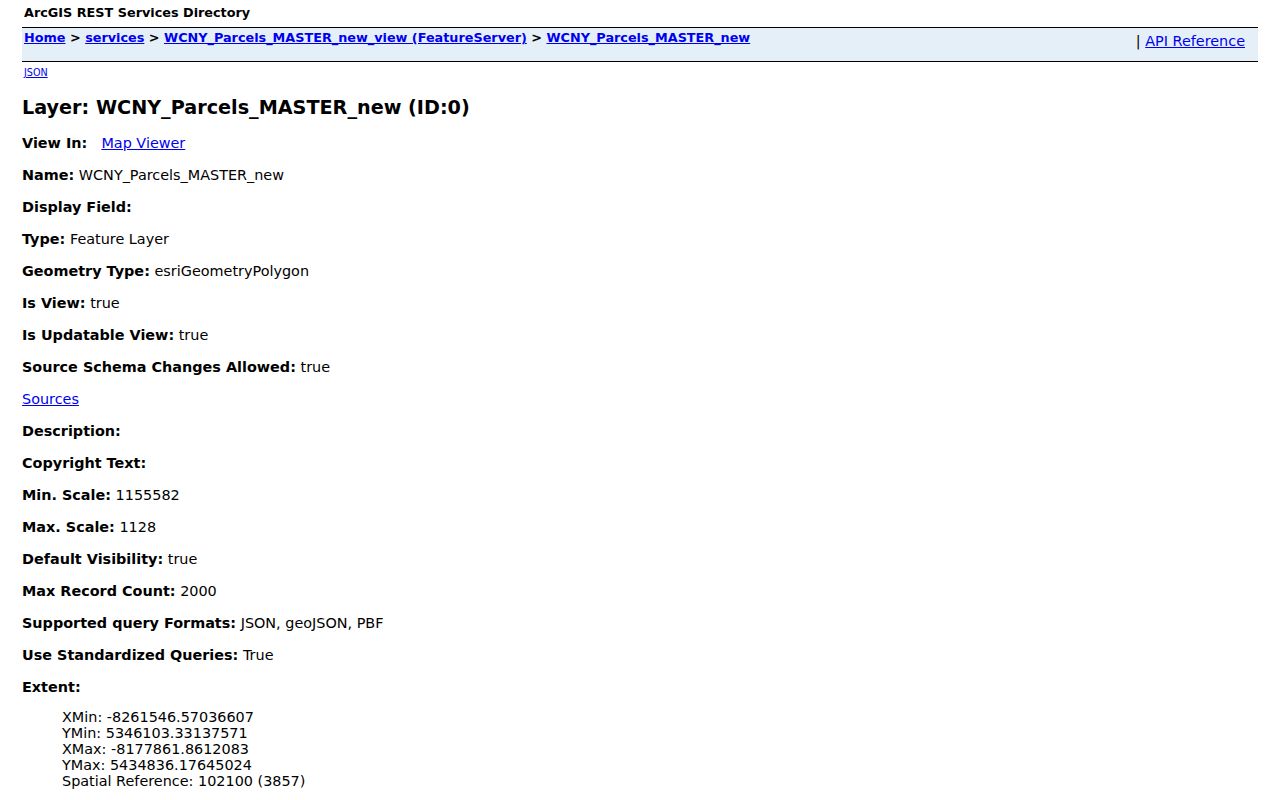
Use the popup as a pointer. Carry the deed book and page into the clerk index, and the roll year into assessment research, before drawing any conclusions from the map alone.
Warren County Record Types
Each Warren County record set answers a different question. A deed documents a conveyance. An assessment roll places value and taxable status on a parcel, while a tax account tracks billing and payment. GIS ties mapped geometry to those attributes. Mortgages and liens show recorded claims but never replace the deed. Filed surveys and subdivision maps add dimensions and lot context, and permit records document approved work rather than ownership.
| Record Type | What It Documents | Kept By | Access |
|---|---|---|---|
| Deeds | Recorded transfers, parties, dates, and legal descriptions | Warren County Clerk | Guest index access; copy charges apply |
| Mortgages & liens | Recorded security interests and claims | Warren County Clerk | Guest index access |
| Tax & assessment | Assessment, taxable status, exemptions, and bills | RPTS, local assessor, and Treasurer | Public online access |
| Plats & parcels | Tax parcel geometry and filed map context | County GIS and County Clerk | Free viewer |
| Building permits | Permit applications, approvals, and inspections | Municipal building office | Office request and forms |
Choose by question. Use Warren County deed records for a conveyance. The assessment roll answers owner and value questions, while the treasurer or collector handles a balance. A filed map may clarify a lot reference, but only a survey made for the issue settles a disputed boundary.
Warren Deeds Span Two Systems
Warren County deed research spans two systems. SearchIQS carries online real-property material from about 1963 to the present and is searched by name. Indexbooks cover deed indexes from 1813 to 1962. That cutover matters. An empty vendor result for an older owner is a signal to change channels, not proof that no deed exists.
The Clerk's record room accepts in-person research. Staff will not run a title search by phone or for a requester, per the office FAQ, so come prepared with owner names, approximate dates, municipality, tax map number, and any known book and page. The Archives extends the trail. Its holdings include land papers, old maps, and assessment rolls, with filed surveys dating from 1786.
The County Clerk online-records page explains how modern and historic access are divided.
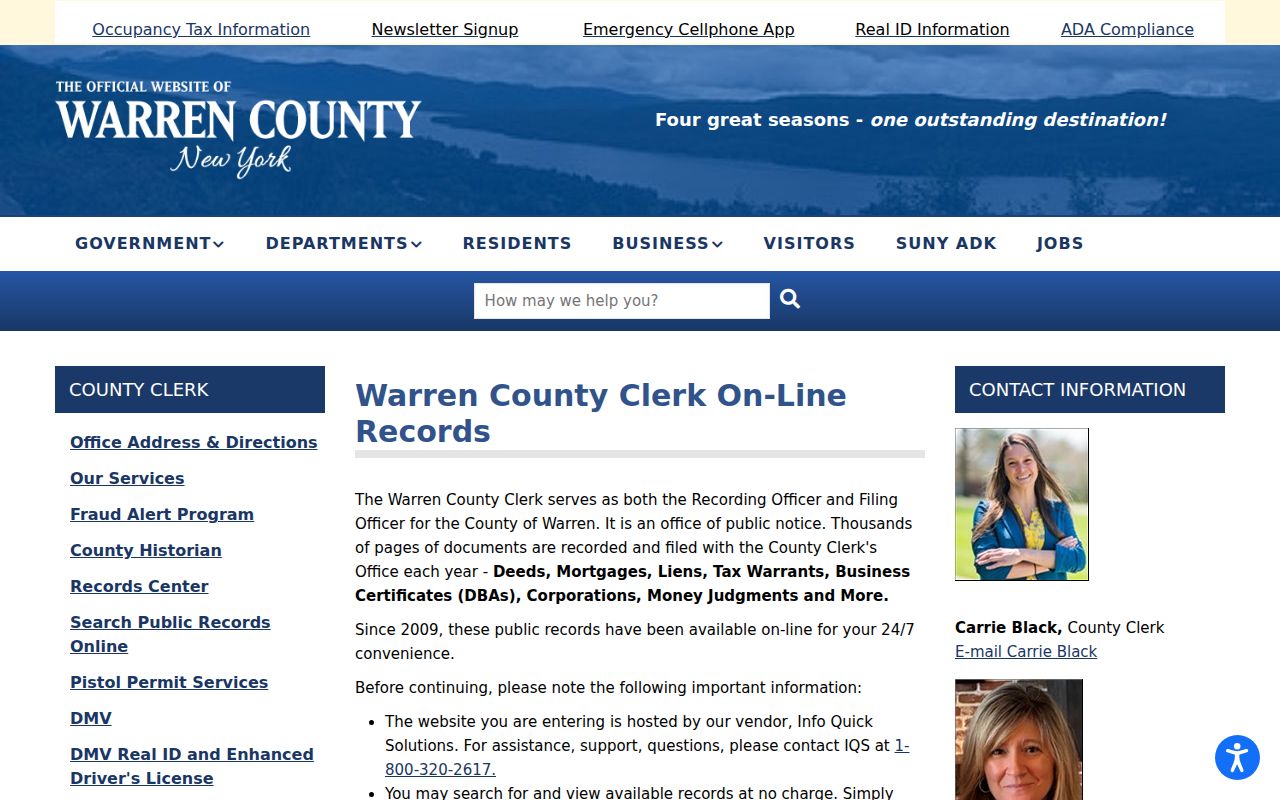
Use its coverage notes before deciding where the next chain link should be searched.
Warren Assessment Dates Matter
Warren County assessments run on a fixed annual clock. Taxable status is set on March 1. The tentative roll follows on May 1. Grievance day falls on the fourth Tuesday in May, and the final roll closes the cycle on July 1. Because the county posts final rolls and alphabetical indexes by municipality, pair every value you cite with its roll year and assessing unit, and the official assessment calendar image below anchors those stages.
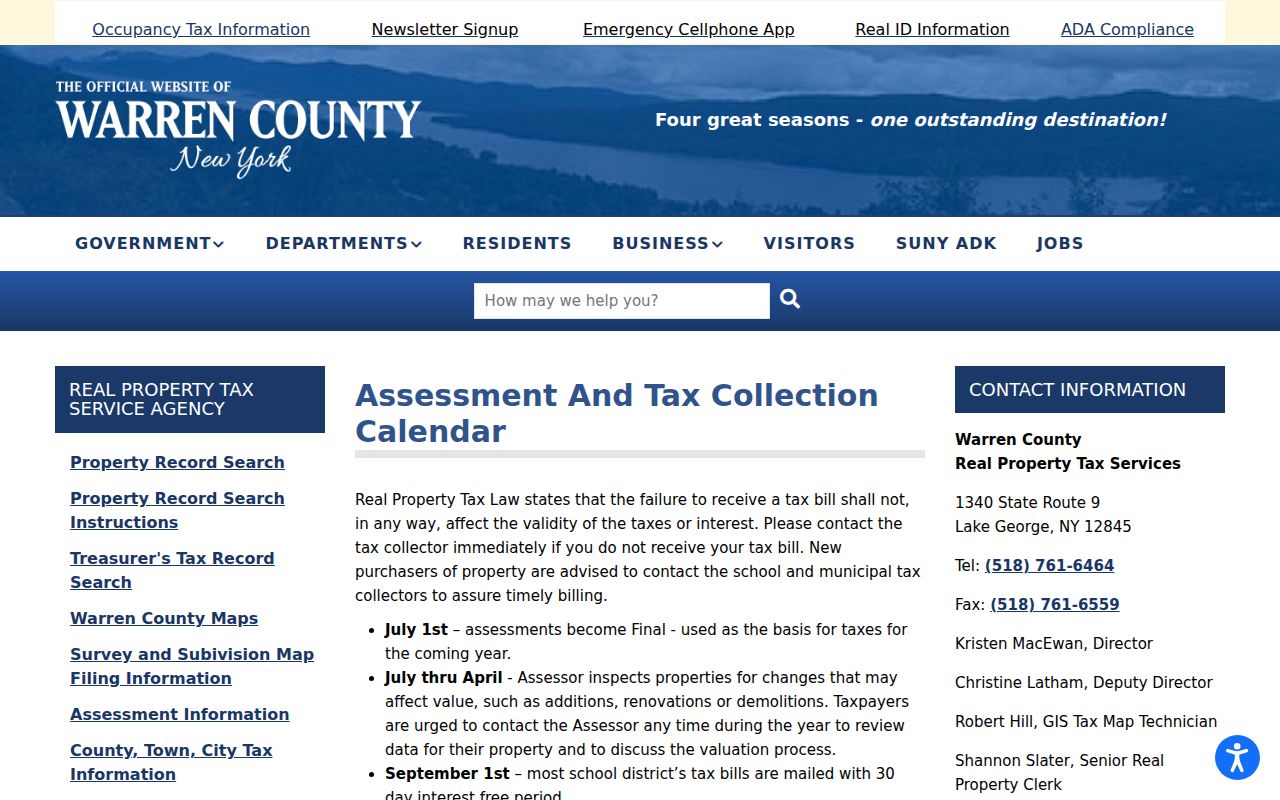
Deeds move faster than rolls. A sale recorded after the roll snapshot can reach the clerk index while the displayed owner or value still shows the prior state.
Maps Add Warren County Context
The Warren County GIS viewer layers parcels over municipal and ZIP context, zoning, imagery, flood data, Adirondack Park classifications, and wetlands. Its tools go well beyond viewing. Parcel identify, detailed search, selected-result export, and print functions all support that work. Still, the layers are reference data. A deed description or land-use question gains context from them, but regulatory status stays with the agency that administers the rule. Downloads cover final-roll parcel files from 2021 through 2026. Comparing dated files can show when an identifier, owner field, or assessment changed, though a change alone does not prove a conveyance. The recorded deed supplies that evidence.
Warren Property Fraud Alerts
The County Clerk offers a free SearchIQS alert tied to a name and email, sending notice whenever a deed or mortgage is recorded under an enrolled name. Common names trip false alarms. Check every alert against the actual instrument and parcel. The county's fraud-alert instructions appear on the page below.
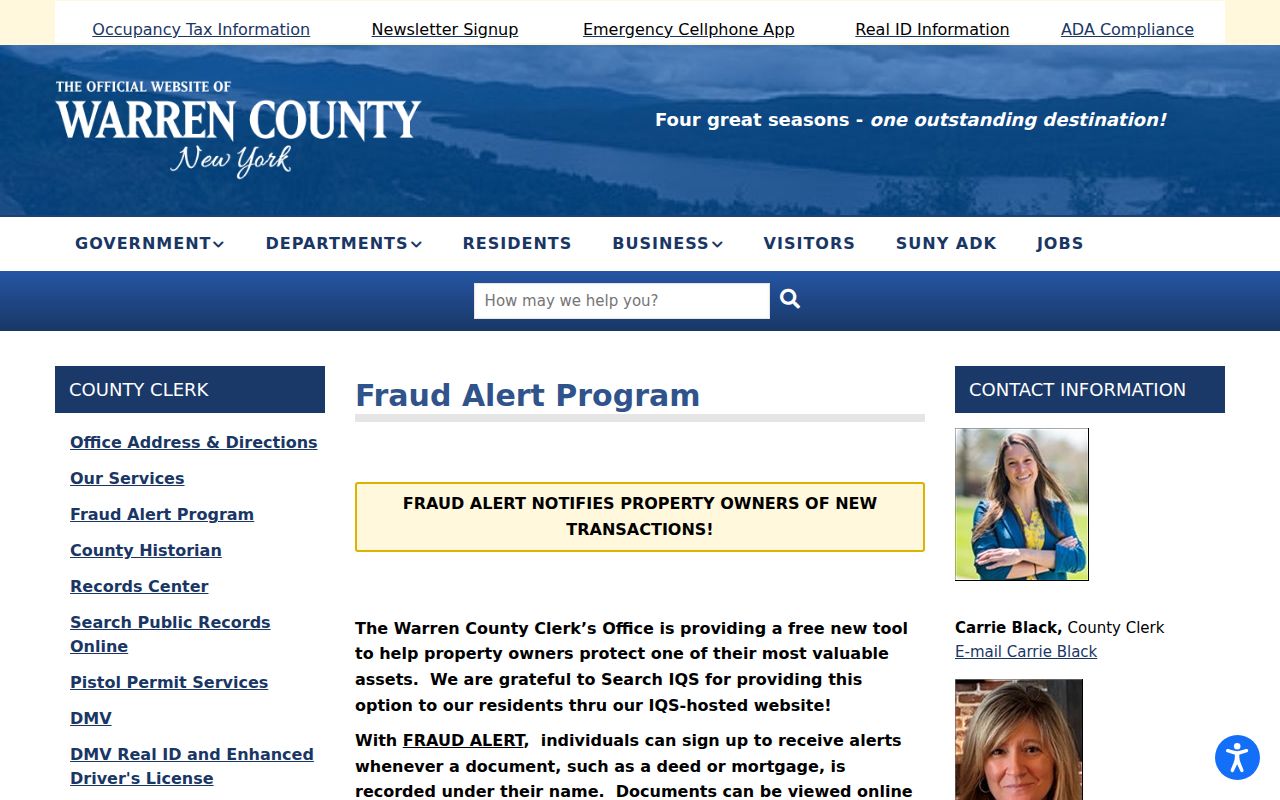
It is early warning, not title insurance, a certified deed, or a legal determination.
Limits of Warren County Property Records
Warren County property records answer real questions. They show the roll owner, the grantee in a deed, assessed and taxable values, recorded mortgages, liens, filed maps, and some building facts. Limits still apply. No roll confirms occupancy. Records do not guarantee clear title, fix a surveyed line, or replace a market appraisal, and a mailing address may be a service address or post office box. Use the data only for lawful property research. New York's Address Confidentiality Program and confidential voter registration shield sensitive locations in qualifying cases. If a record seems to expose a protected person, do not republish the address. Ask the custodian how the confidentiality rule applies instead.
Lawful use. Warren County property records are open for property research, due diligence, and civic transparency; a records search does not replace a title company or a licensed surveyor, and misusing owner information to harass anyone is a crime under New York law.
Warren County Archives Extend Records
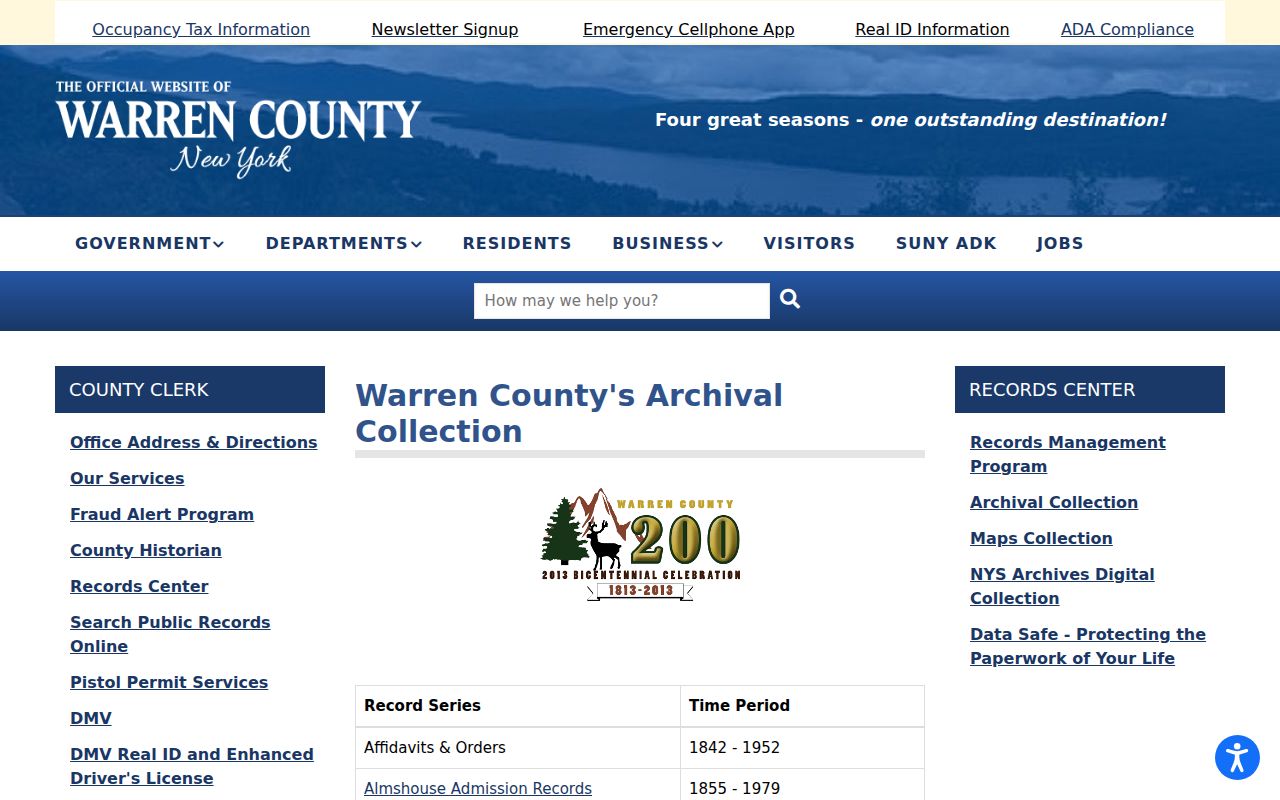
Online Warren County property records are just the newest layer. The Records Center and Archives reaches much further back than any web index. Its finding aid lists surveys and indexes beginning in 1786. Deeds and mortgages date from 1814, and judgments from the early 1800s. Assessment and tax rolls start in 1854. Those series matter when a modern parcel number or web index no longer reaches the event. They are separate collections, not one database. A strong request names the municipality and approximate year. It should also include the owner, record type, and any known map or book reference. Without those details, staff must guess. The Warren County Archives finding aid is shown below.
An archive index or historian abstract is only a lead. Pull the underlying deed, roll, filed map, or court record for the fact it actually records.
Warren Tax and Foreclosure Records
Tax responsibility in Warren County moves among offices. Local collectors handle current bills. The County Treasurer handles delinquency and foreclosure functions, while RPTS supports the roll and tax-map framework. The county's 2026 materials set a July 31 final redemption date for taxpayers notified in that foreclosure cycle and an October 17 annual auction date. Those dates are not evergreen. Verify each parcel's notice with the Treasurer. Local Law No. 3 of 2026 permits installment agreements for delinquent real-property taxes across property classes. The lien remains. Compliance pauses foreclosure and default can restart enforcement, so read the account, the law, and the Treasurer agreement together rather than treating an agreement as forgiveness.
A stubborn Warren County parcel needs a compact question. List the municipality, present and former owner names, approximate transfer year, print key or SBL, deed book and page, old address, and likely instrument type. Say whether the issue concerns title, map, tax, or permit records. That framing lets the custodian find the right series. Nobody gets asked to run a title search.
Keep a dated citation for every Warren County source. Rolls, parcel layers, tax accounts, and recording indexes update on different schedules.
Official records deserve their dates, custodians, and stated limits. A careful search preserves all three.
When a source changes, keep the earlier citation and explain the newer result. That matters most for owner fields, assessment values, tax status, and parcel geometry, since each follows its own update cycle and custodian process.